Voice-first player development for hockey teams.
Capture your thoughts by voice — from the bench, at practice, or a quick note after. RinkNotes synthesizes them into clear per-player reports, stats, and next steps.
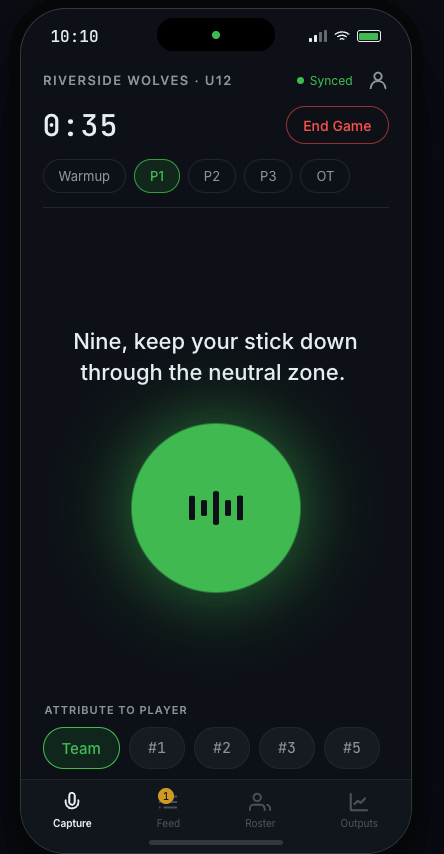
One spoken note. The whole workflow.
Add your roster. Nothing is captured-for-sharing until a parent grants consent — per player.
Tap, your AirPod, or say “RinkNotes.” Speak in a game, at practice, or free-form. Say the game — it’s created. Say the score — it’s tracked.
Each note is sorted by category, tagged to a player, and turned into feedback, stats, and suggested drills — you confirm before anything counts.
Parents get a clear, encouraging report — only the players they’re allowed to see, only what they’ve allowed.
Everything you’d write down — captured before the next whistle.
Speak one note from the bench and it lands in your review feed — sorted, tagged to a player, waiting for a tap to confirm. What you approve becomes the report a parent actually reads.
Walk through itNine, keep your stick down through the neutral zone.
Seventeen threaded a beautiful saucer pass right through the seam.
Twenty-two won that battle in the corner and came away with the puck.
Seven read the two-on-one perfectly and took away the cross-ice pass.
Four’s edge work on the backcheck was excellent tonight.
Battle-level was the story of the week — Liam won pucks down low and backchecked hard every single shift.
Beautiful puck protection in the corners against Northgate. He’s becoming the guy we trust to come out of a scrum with it.
Great patience on the half-wall — waited for the seam instead of forcing the pass. That read is ahead of his age group.
Next step we’re working on together: carrying that compete into the offensive zone and getting to the net after he wins it.
It only feels simple.
The hard problems are handled for you — you never have to think about them.
Tuned on real coaching language and your own categories — it knows a saucer pass from a stick lift, and a backcheck from a battle. Not a generic AI guessing at keywords.
Consent is enforced in the database, not just as a checkbox on a screen. Withdraw it and the access disappears everywhere, immediately.
A parent can see, export, or pull their child’s data anytime. It’s their family’s data — RinkNotes just holds it carefully, and hands it back on request.
Say the game — it’s on the schedule. Say the score — it’s tracked. Stats and scoresheets fill themselves in from what you already said. No forms between you and the ice.
Every gap the feedback finds comes with drills that target it — pulled from a library built for exactly what your team needs next. Practice time stops being guesswork.
Add your own categories, your own language for what matters. Every note your coaches confirm sharpens what it notices next — tuned to your program, not a one-size-fits-all model.
Built for hockey at every level.
From a first-year minor team to a AAA program, a junior club, a university roster, or an adult league — the same voice-first development, configured for who you coach.
Goalies get their own track — not skater stats with a mask on.
Most team apps treat a goaltender like a skater with odd numbers. RinkNotes gives goalies a development track of their own: goalie stats, goalie-grounded feedback, and drills built for the crease — with a hard rule that a goalie is never handed a skater’s drill.
Saves, goals against, and workload — tracked from what you say, on a stat line built for goaltenders instead of goals-and-assists with a mask on.
Depth, angles, post play, rebound control, puck tracking — the report is grounded in goaltending development, not generic hockey language.
A goalie is only ever offered goalie drills. If none fit the focus area yet, the plan says so plainly — it never substitutes a skater drill to fill the space.
The same voice-first flow you already use. Say who you’re watching, and the stats, feedback, and drills follow the position.
Beyond the season — camps and tryouts, done right.
Run a multi-session skills camp or an evaluation weekend on the same voice-first capture — skater or goalie. A camp finishes with something families keep; a tryout stays clean on consent.
Each session builds on the last into one cumulative, per-child development report — something a camp can hand every family, not just a weekend of drills.
Numbered sessions with more than one instructor capturing — a snapshot after each session and a cumulative report at the end of the camp.
Evaluating players who aren’t on your roster yet? Consent is collected per trialist before any evaluation, and notes stay de-identified until it is. Reports read as development — never a selection verdict.
Camps and tryouts each run a dedicated goalie variant, grounded on goalie development — the same clean split as the rest of the product.
Credible enough for a program that answers to someone.
Consent is configured to whoever owns the decision — a parent for a minor, the player for an adult. The same architecture, set per team. It’s the reason a junior program or a university department can run RinkNotes under its own compliance obligations.
RinkNotes never invents a drill or a rating on its own. Every note is confirmed by a coach before it counts, and drills come from a reviewed library — not a guess. It amplifies your eye on the ice; it doesn’t replace it.
The bench sees everything.
Now it remembers — for every player.
Set up your team in about ten minutes. No player logins, ever.